
Monte-Carlo Casino Games, Live Casino and Mobile Features – Historical Guide
 Available in AU
Historical product overview | Updated 27 August 2026
Historical records for the online Monte-Carlo Casino document a multi-provider games catalogue that included NetEnt, Microgaming or Games Global, Yggdrasil, Thunderkick, Amaya or Chartwell and Jadestone. They also document live-casino games, mobile-browser play, a historically reported dedicated app, multiple interface languages and customer support by live chat and email. Those details describe the former online product, not a live 2026 casino. Current exact-brand listings as of 27 August 2026 mark the online operation closed or no longer open for business. The historical description keeps old features in the past tense and does not turn them into current availability, app-download advice or a route to a mirror site.
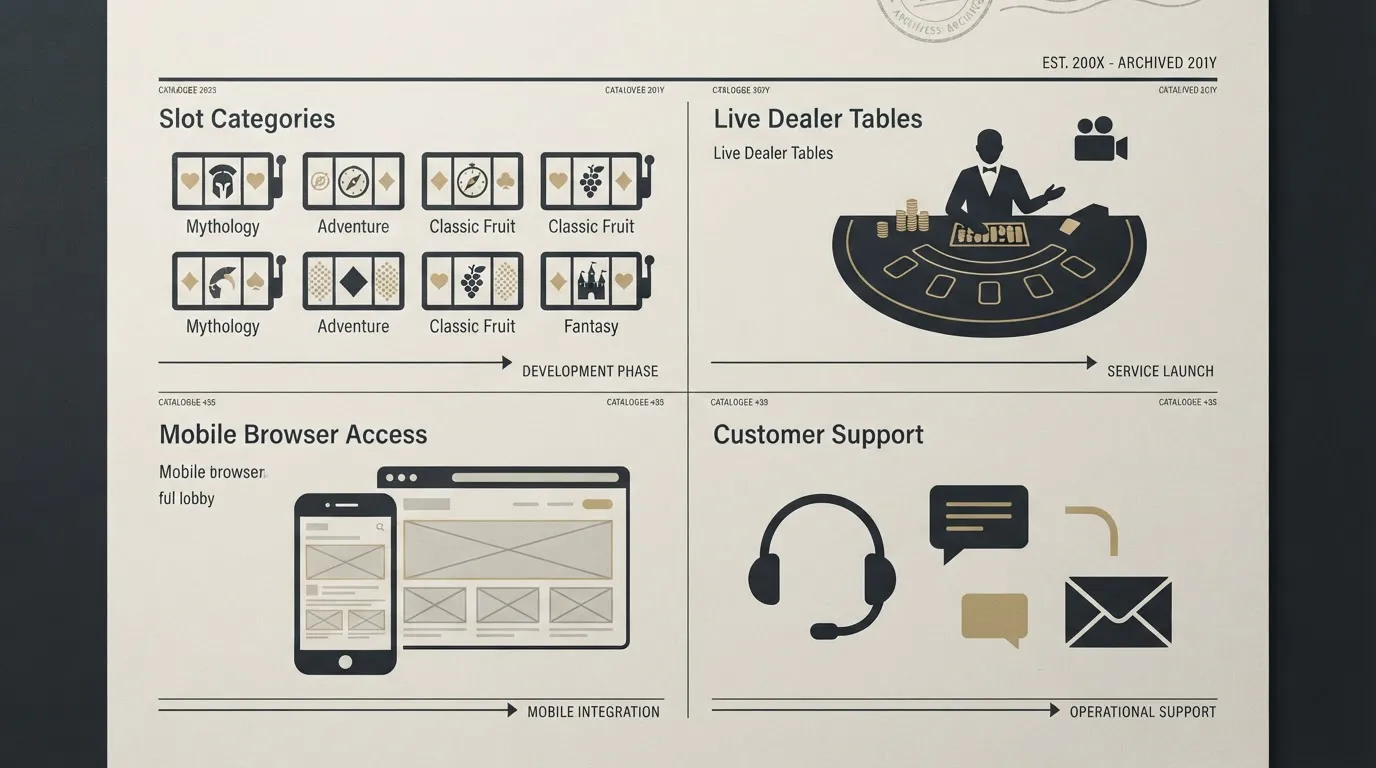
Historical feature snapshot: the provider list below is preserved from independent review records and should not be read as a current lobby inventory.
Games and providers: Historical games and providers
The old Monte-Carlo Casino game library is best described by provider and category rather than by a single total game count. Historical records repeatedly list several recognisable suppliers while varying on the size and composition of the catalogue. Historical records include NetEnt, Microgaming or its later Games Global label, Yggdrasil, Thunderkick, Amaya or Chartwell and Jadestone. Some archives list additional suppliers, but the core set above appears consistently across the surviving historical records.
This distinction matters because exact catalogue totals age badly. Online casino catalogues can change as provider agreements, regional restrictions and platform integrations change. An old catalogue count may have been accurate on its date and still be misleading for another period. For a brand that is now closed, there is no live lobby to reconcile those historical counts against. A provider-led description preserves useful historical product information without implying a precise lifetime catalogue size.
| Historical record | Historical detail | What does not follow today |
|---|---|---|
| Provider lists | NetEnt, Microgaming/Games Global, Yggdrasil, Thunderkick, Amaya/Chartwell and Jadestone were documented | That every supplier remained available until closure |
| Game categories | Slots are documented, with live-casino availability documented separately | A current playable catalogue or current provider contract |
| Archived catalogue totals | They indicate that the product used multiple providers | One exact lifetime game count |
A reader looking at the old brand can therefore use the supplier mix to understand its market position. It was not presented as a single-software skin with a tiny fixed catalogue. A complete final lobby cannot be reconstructed reliably from the surviving fragments, so an exact title-by-title catalogue is not presented.
Historical feature snapshot: live dealer availability is supported as a category-level fact, not as a current table schedule.
Live casino was part of the historical product
Multiple historical records describe a live-casino component, so the former Monte-Carlo Casino can be described as having offered live-casino games. It does not establish which tables were live on the brand’s final operating day, which studios were available in a particular country, or what table limits applied to an Australian user.
The category is still important because it changes how the old product should be understood. The brand was not documented only as a slots catalogue. Live dealer games sat alongside conventional RNG casino content, giving the historical service a broader casino format. CasinoListings, for example, still preserves live-dealer references on its closed-brand page. Those details describe the former product and do not point to a surviving service.
Historical feature snapshot: mobile access existed in the old product, but no current app or mobile service is represented as available.
Mobile browser and the historically reported app
Historical records consistently support mobile-browser play. In practical terms, that means the old Monte-Carlo Casino could be accessed through a mobile web experience rather than requiring desktop-only software. Separate historical records also mention a dedicated mobile app. The app belongs in the past tense because an old listing does not mean the app remains in a store, works on current operating systems or connects to an active casino service.
This can happen with old casino listings. An old listing can preserve a field such as “Mobile” or “App” years after a casino closes. Search engines may continue to surface the page, and an old app reference may look like a current download recommendation when separated from its date. For Monte-Carlo Casino, the correct 2026 reading is simpler: mobile browser play was historically supported; a dedicated app was historically reported; no current app availability is claimed here.
The last point is especially important for this brand because the Monte Carlo name also refers to the active physical Casino de Monte-Carlo in Monaco. The online product and the venue are separate identity questions. The site’s online brand identity page handles that distinction in detail.
Historical feature snapshot: language and support details below are legacy service records, not current contact promises.
Languages and customer support
Historical records consistently list English, Finnish, German, Japanese and Norwegian among the languages supported by the online casino. They also record live chat and the support email address [email protected]. Those points help reconstruct how the service was organised for international users, but they do not prove that the mailbox is monitored today or that a live-chat endpoint still exists.
| Legacy service item | Historical record | 2026 interpretation |
|---|---|---|
| Languages | English, Finnish, German, Japanese and Norwegian | Historical interface or service languages only |
| Live chat | Documented historically | Current availability unknown; historical hours conflict |
| [email protected] | Historical contact address; current monitoring unknown | |
| Mobile browser | Historically available | No current access |
| Dedicated app | Historically reported | No current app-store availability |
Historical support-hour records conflict: some describe broad or round-the-clock availability while others give more limited hours. Live chat existed, but the surviving records do not establish a precise 24/7 schedule.
Historical feature snapshot: The closed status keeps old product details in their historical context.
Why these features are not presented as current
As of 27 August 2026, AskGamblers labels Monte Carlo Casino “Closed” and states that the casino is closed. CasinoListings, on a page updated in February 2026, says the casino is no longer open for business. Those current closed-status records keep the historical feature set in the past tense; there is no current basis to describe a relaunch.
The closure conclusion is separate from the existence of the physical Casino de Monte-Carlo in Monaco. The famous land-based venue remains active, and search results about that property can easily drown out the older online-casino record. They do not reactivate the former web casino. For the records chronology, see the brand closure history.
This separation also protects against mirror-site confusion. A website using a similar name, imagery or Monaco theme is not automatically the same regulated entity, operator or historical service. No registration links, download links, alternative domains or clone recommendations are provided. The historical product details should not be mistaken for a current access route.
Historical feature snapshot: product categories answer a different question from payments and licensing.
What historical features do and do not tell you
The provider list shows which software ecosystem the old casino drew from. Live-casino records show that dealer-led tables formed part of the product. Mobile and language records describe access format and service localisation. Support records show how users could historically contact the operation. None of those facts establishes current Australian access, a current licence, a deposit method or a withdrawal route.
Keeping categories independent prevents a subtle mistaken conclusion. Visa on an old cashier list does not establish that the old mobile app accepted Australian Visa cards, and a foreign-language interface does not establish country eligibility. Those jumps are not justified. Payments are handled separately on the historical payments page, while licence history is documented on its own page.
A historical feature belongs to the period in which it was documented. It does not become a current service feature simply because the old detail survives in search results. This distinction matters with closed gambling brands because historical pages may remain indexed for years.
Historical feature context: product details are kept separate from current operating status.
How to interpret old casino features
- Current operating status first. For an old feature, first establish whether the exact online brand is active or closed; that determines whether the feature is current or historical.
- Repeated historical records. Provider, language, support-channel and mobile details that appear in multiple historical records are more consistent than a single isolated listing.
- Avoid unstable totals. Exact game counts and support hours vary across dates in the historical material, so no single fixed figure is used when the records conflict.
- Separate categories. A game provider does not prove a payment method; a language does not prove country access; a mobile record does not prove a current app.
- Do not treat archival material as a current access route. Information about a closed brand should not lead readers to mirrors, substitute domains or unofficial downloads.
A narrower historical description avoids carrying stale fields into the present. It keeps durable product details while leaving uncertain or time-sensitive items out.
Further reading
Bottom line
The historical Monte-Carlo Casino was a multi-provider online casino with slots and table-style content, live-casino games, mobile-browser access, a historically reported dedicated app, several language options and live-chat/email support. The recurring provider list includes NetEnt, Microgaming or Games Global, Yggdrasil, Thunderkick, Amaya or Chartwell and Jadestone. No exact total game count is given because the surviving historical records do not provide one stable figure. Most importantly, these are archived product facts. As of 27 August 2026, current exact-brand listings mark the online casino closed, so the catalogue, mobile and support details are historical rather than a current service offer.
Return to the Monte-Carlo Casino review for the full historical and Australian context.
The full picture is in the Monte-Carlo Casino review for Australia.
How money moved through the brand: payments and withdrawals.
Recommend
Content created by the «montecarlocasinoau.com» team